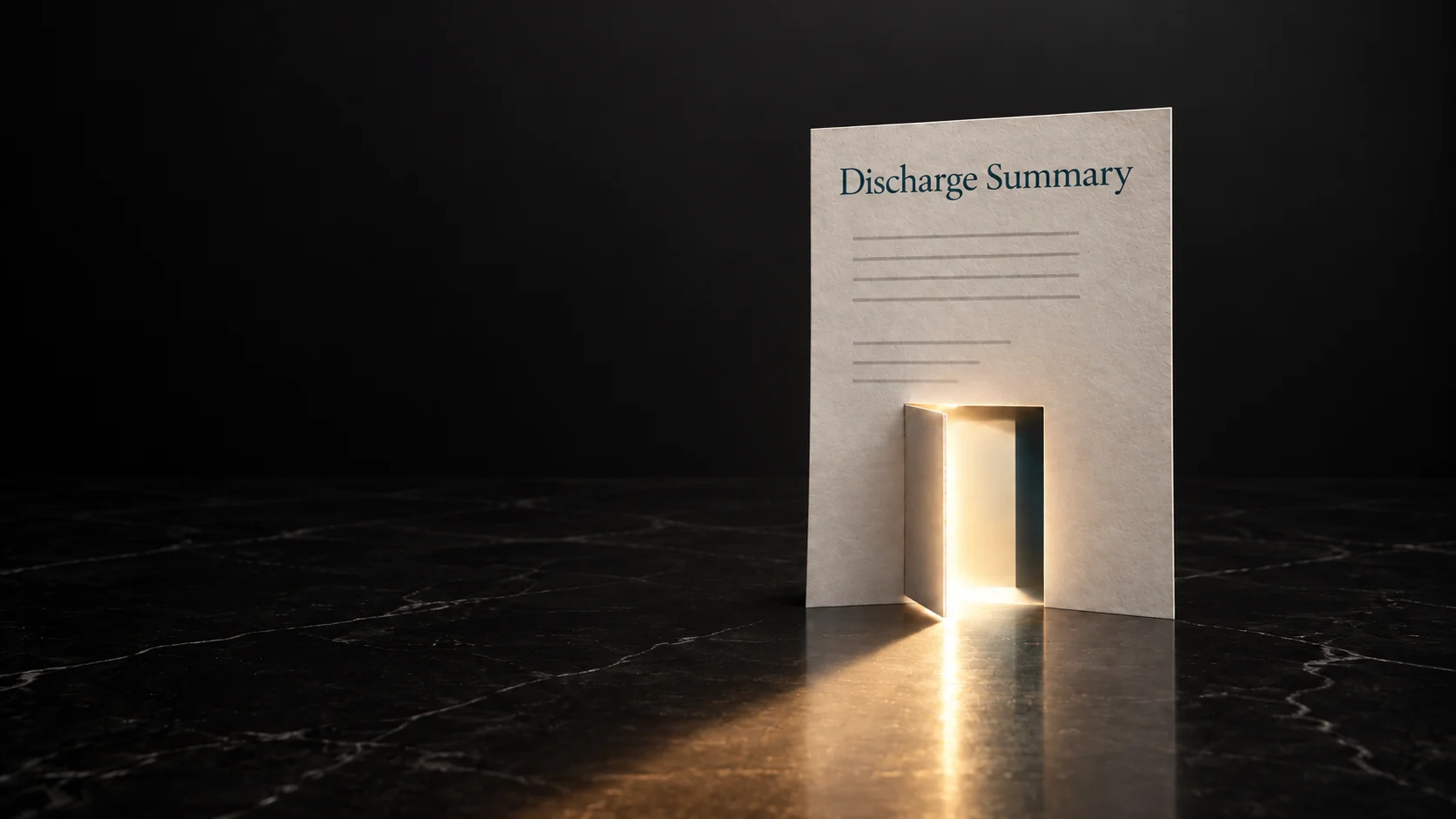
A consultation leaves a lot to take in. At home, tired or worried, the patient has to find the part that matters today — and make sense of it.
02
The care team
The phone rings. The question returns.
“Could we answer the day-five question before day five?”
New to the patient. Familiar to the team. A predictable recovery question can mean worry at home and staff time spent explaining the same thing again. We often know what is coming, yet answer one person at a time.
And when something feels wrong, stress is high. Hunting through letters for a number — or calling a switchboard without knowing how urgent the problem is — adds to the burden.
03
The clinical author
Before the words reach a patient.
“Which words did we approve?”
And which edition did this person receive?
Who checked the words, and on what evidence? The clinical author needs to be able to return to the approved published edition.
The Suite preserves the published edition, so the clinical author can return to the words that were approved.
Why an update leaves a trail of older copies
Edition 1Still on paper
Edition 2Saved on a device
Edition 3The current master
“Leaflet given” does not preserve its wording. Updating the master does not retrieve old photocopies or downloaded PDFs.
A page to keep. An answer on demand. Help with the writing.
For the patient
“Put it all in a leaflet.”
Something they can keep. Everything in their hands.
Follow this ideaReturn to the promise
The words are there. Can this person use them?
The first challenge is access: finding the right passage, reading it and making sense of it when tired or worried. One fixed presentation may not meet every reading need.
One page, different readers One page. Different reading needs.
Aa
Find itCan I locate the part I need?
Read itCan I see and navigate the words?
Make sense of itDoes the explanation work for me?
A well-designed leaflet can be accessible. The problem is treating one fixed format as sufficient for every reader.
Well-designed leaflets can be accessible. Their second challenge is keeping references and editions identifiable: a printed or saved copy does not update with its source.
For the patient
A chatbot instead of a long leaflet to prepare for surgery?
The answer, whenever they ask.
Follow this ideaReturn to the promise
But what about the question they don’t know they need to ask?
Someone preparing for surgery may not know which risks, alternatives or decisions need a conversation. The clinical team must decide what to explain without waiting for the patient to find the right prompt.
The Montgomery duty to inform.
The clinician must take reasonable care to make the patient aware of material risks and reasonable alternatives. What matters depends on the person’s circumstances and priorities.
Consulting AI for problems after an operation?
Does the answer fit the surgeon’s technique, the procedure and the recovery instructions the team gave? Missing context or a leading, incomplete question can steer the reply.
Recovery needs guidance reviewed by the team responsible for the operation, including when and how to contact them.
What the question can leave out
Someone at home may not know which detail matters or how to describe it. These examples explore the framing of a recovery question.
The question sets a direction.
The starting words
“This has changed since yesterday. What should I tell my team?”
?
The conversation’s starting focusDescribing a change
The question starts with a change and asks what information the team needs.
Illustrative questions, not patient quotations or generated answers.
And a portal?
A useful portal can organise a journey, stage the information and keep contact instructions within reach. A folder of attachments still asks the patient to find the right document and work out what matters now. Search helps only when they know what to look for.
AI can help prepare information. Sources and citations still need checking, meaning needs review, and a named clinician must decide what can be published.
The work after the first draft
A new prompt can produce a different answer. Clinical authors need to review the meaning and coverage of each reading version, approve the publication and retain that edition.
“We can write the documents ourselves.”
Clinical authors can do this work well. Sources, review, accessible versions and controlled updates still need a maintained process.
A journey for the patient. A foundation for the team.
A clinical information platform connecting preparation, recovery and the work of writing, reviewing and publishing guidance. Polaris before surgery. The Compass through recovery. The Helm behind both.
A patient journey. A clinical foundation. A conversation worth having.Explore the apps
Polaris Before surgery
Room to take it in. Time to come back.
Preparation becomes a pathway you can move through. Read the explanation, find the questions, return to the details. The information is organised around getting ready.
Switch the reading mode. The words and the original screen change together.
Standard · Excerpt from the demonstration
Finding your place
Read the step that matches where you are in the journey.
Moving on
Move on at your own pace. The pathway never rushes you.
Two exact passages from “How a Polaris page is built”. Intervening text omitted.
Standard. The full demonstration explanation, with headings, numbered steps and examples.
Easy Read · Excerpt from the demonstration
Finding your place
Read the page.
Moving on
Go to the next page when you are ready.
Two exact passages from “How a Polaris page is built”. Intervening text omitted.
Easy Read. A shorter explanation of the same topic, selected through the product’s own control.
A choice of words, as well as a choice of presentation.
More from the preparation app
See how preparation takes shape.
Real product screens. Select a screen to look closer.
A pathway you can return to.The phases and named review are visible alongside the procedure introduction.Look beyond a headline number.The demonstration shows risk explanations, labelled sources and an Easy Read option.
The Compass After surgery
Home is where new questions begin.
Recovery guidance is organised day by day: what to expect, the explanation behind it, and the guidance for that stage. A place to return to as the days change.
The clinical author defines the scope. Existing material and selected sources give the draft its foundation. The draft begins with those sources.
Make it understandable.
Assisted drafting prepares material for clinical review. Standard and easy-read content need attention to meaning, coverage and their sources.
Make the decision human.
A named clinician reviews the information and signs off the version they are prepared to publish.
Keep the published version.
Keep the published edition, its sources and the clinical decision behind it.
The draft reaches a human decision.
Clinical responsibility is visible inside the workspace.
A home for the clinical work.The dashboard brings content, approvals and patient invitations into view.A draft starts with a clinical brief. The generation screen states: A clinician must review and sign off the result before patients can see it.
The foundations beneath the experience
Built on clinical responsibility.
Safety, privacy and governance shaped Patient Compass Suite from the beginning.
Safety
Decisions recorded. Changes checked.
Documented architecture decisions and automated checks support the clinical work.
Privacy
Useful guidance. Fewer identifiers.
Patient-Compass does not require the patient’s name, email address, date of birth or clinical identifier.
Governance
A named clinical decision.
Clinical review and sign-off precede publication. Published editions retain their history, with a clear owner for updates.
Feedback received. Early anonymous responses cover Polaris and The Compass.
The next investment. Structured patient co-design.
A first conversation can start with something real.
The existing catalogue offers preparation and recovery pathways, with depth in urology and andrology. A consultant can begin with a familiar procedure.
Start with a familiar procedure. Review the pathway with your clinical team.
The Helm The Compass
One page. Look at the shadow it casts.
A clinical team can bring preparation and recovery together around information that patients can use and clinicians can stand behind.
A guided trial can explore how that might work in your service: technology people can use, inclusion people can experience, and responsibility that stays visible.
A proposed first conversation. The people, scope and responsibilities would be agreed together.
How could the first conversation take shape?
A practical starting point.
Make the introduction
Bring interested consultants into the conversation.
Bring the right people together
Identify the appropriate service and assurance colleagues.
Choose a procedure
Clinical content decisions stay with the participating consultant.
Prepare the demonstration
GGO Systems can prepare the demonstration and propose a support arrangement.
A useful decision at the end.
Is there a consultant trial worth scoping, who would own it, and what should it help us learn? The participating team would shape the service and patient-involvement questions. GGO Systems would gain product learning and potential commercial customers.
Prepare and edit the introduction
This prepares wording for you to share. Nothing is sent from this page.
How the guided trial would work
Before provisioning, agree the procedure, clinical owner, readiness of the intended route, support and learning questions. The 90 days start at environment provisioning and include clinical review.
At day 90, review aggregate usage and any separately agreed feedback, then decide whether to stop, continue on a commercial plan or explore a separately scoped service proposal.
Wider deployment, funding, content reuse and any external account of the service’s involvement would each need separate agreement. There is no automatic renewal or charge at the end of the trial.