Skip to content

For the private consultant surgeon

If your patient information is still a PDF

Patient information in private practice is often a PDF: some of it written personally, some inherited, some a society leaflet used because there was never a clear week to write your own. It is emailed after the consultation, and version control amounts to a filename. If that describes your practice, this page sets out what a maintained, accessible patient pathway changes, what stays under your control, what it costs, and what it deliberately does not do.

Test your own leaflet →

1. What changes

You are not starting from a blank page. Pathway content is drafted for you and comes to you for review. Where you have your own approved leaflet or guideline it is the primary source and takes priority over generic material. Where a source is silent, the gap is marked for clinical review rather than filled in.

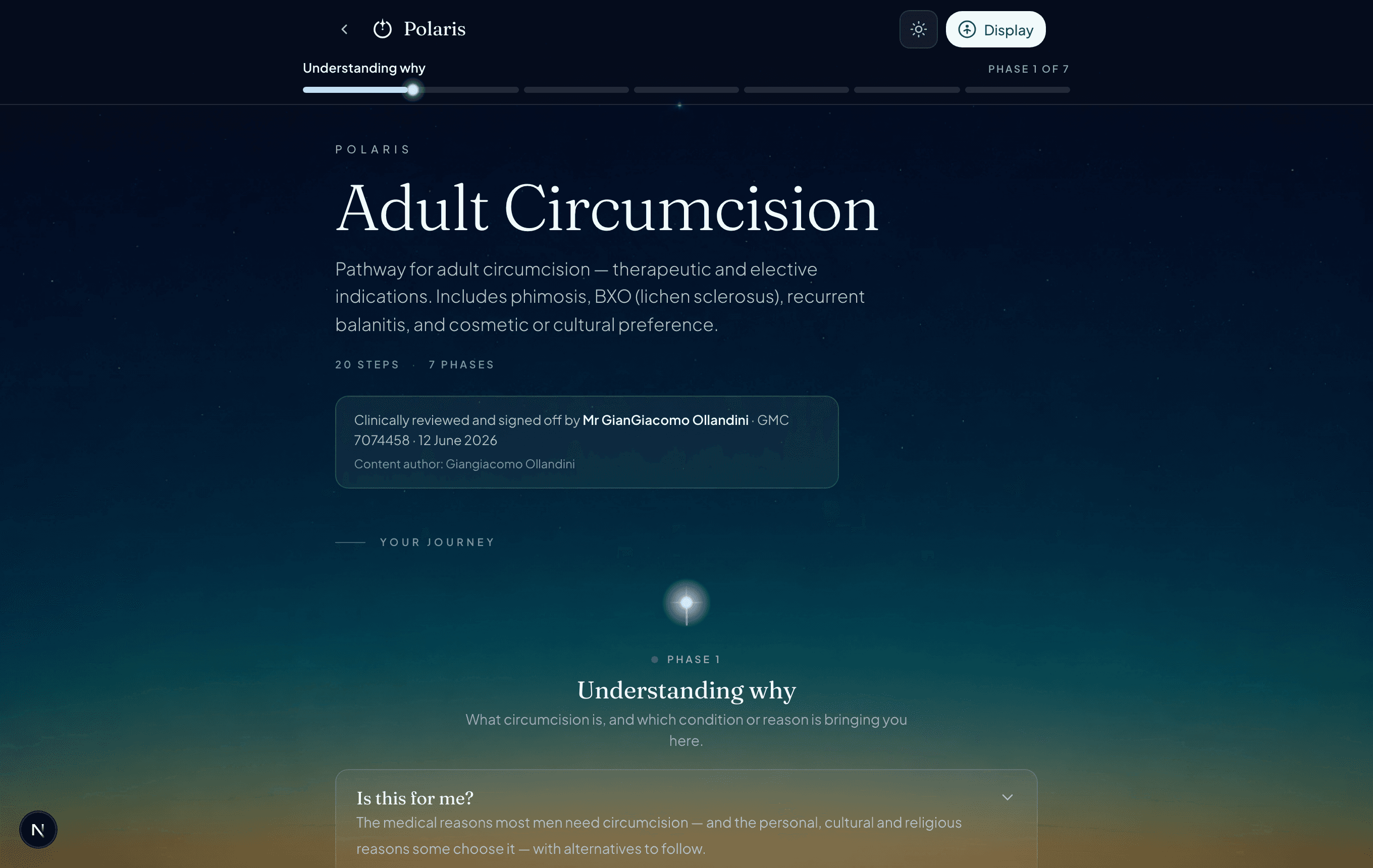
The explanation exists outside the consulting room. A paced, step-by-step pre-operative pathway (Polaris) takes the patient through the operation, the options, the risks and the preparation, in their own time.

Recovery information is organised by post-operative day. The recovery companion (The Compass) holds day-level content the patient can move through as their recovery progresses, rather than a single document read once before surgery.

Alignment to your source is a tracked state, not a memory. Each item records the source document type, the version it reflects, the date it was last synced against that source, and an explicit alignment state — in sync, flag for review, or pending source update.

Accessibility is structural. Every step is authored in a standard and an easy-read version; the patient is offered the choice and the choice persists in their browser. (Background: what the accessibility duty requires.)

2. Consistency

At present, what a patient receives may depend on which version of which file was attached to which email, and whether the leaflet had been updated by that date.

With a maintained pathway there is one current published version of each procedure’s content, it is what the link resolves to, and it is the version you signed. When you publish a change, the link resolves to the new version from that point. Where you work alongside other consultants, each signs their own clinical content — a common standard does not require anyone to edit your clinical judgement.

3. What the patient gets

A link or QR code from you, on any device, with nothing to install. The link carries no patient identity and no token — it is the public route into the pathway, and access is controlled at the content layer. Time-limited access links are also available where you want one, with a maximum validity set by your plan.

Before the operation: the pathway, one step at a time, in whichever reading mode they chose, revisitable as often as they want.

After the operation: recovery content organised by day, so they can go to where they are.

Throughout: plain language and short sentences in easy-read mode, a content warning before anatomical detail, no autoplaying media, reduced-motion and high-contrast support, and a minimum 44×44px touch target. Built to a WCAG 2.2 AA baseline with an AAA target for text contrast.

There is no patient login. No accounts, no passwords, no patient self-enrolment.

4. What you keep — and what you sign

Clinical authority stays with you. The team that owns the source documents is the editorial authority for the content in its deployment; the platform supplies the software, not the clinical content.

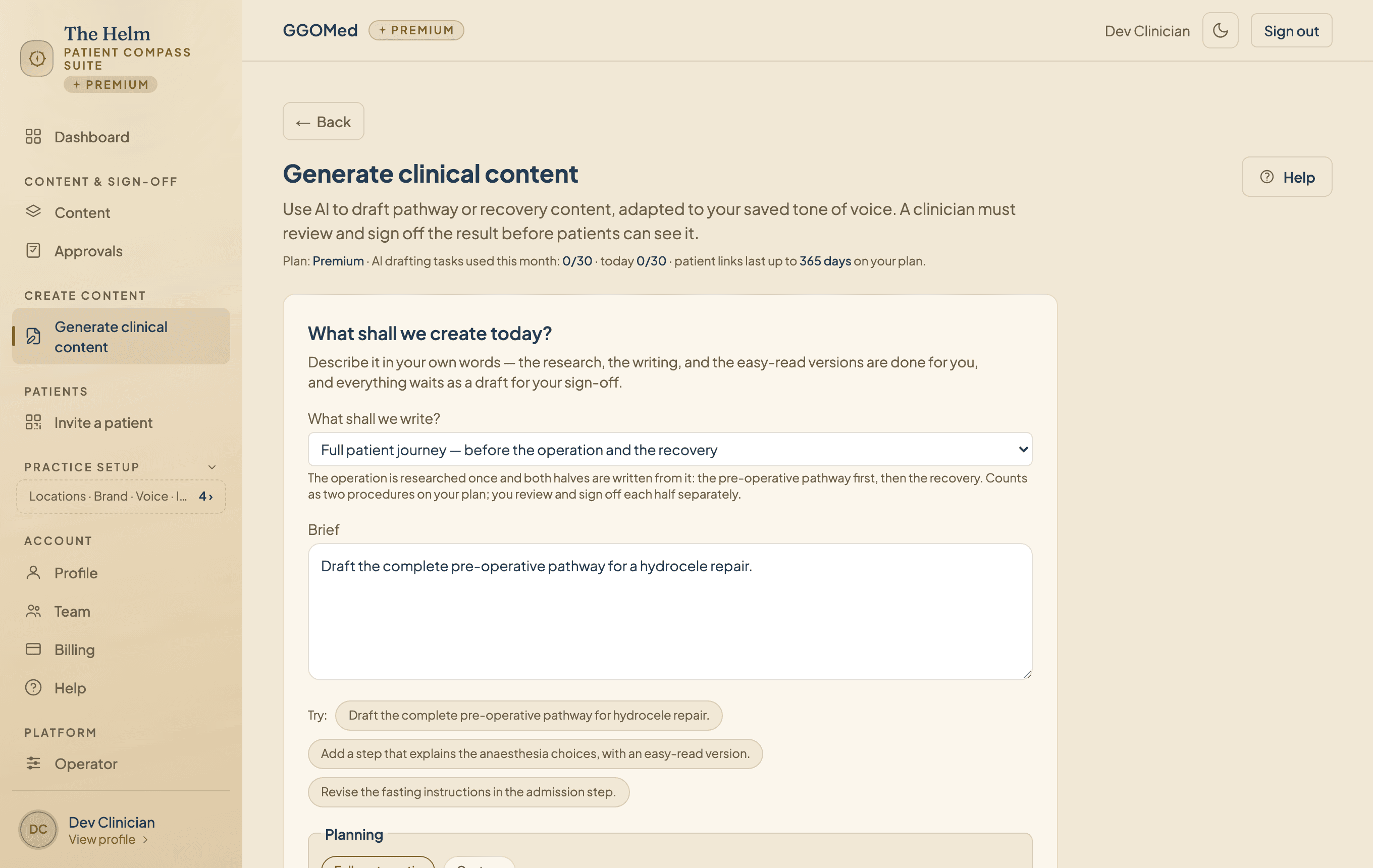
Nothing publishes without a registered clinician’s sign-off. A non-clinical member of staff — a medical secretary or PA — can draft, prepare and request sign-off; the administrative role is blocked from exactly two things, the clinical sign-off and self-registering a GMC number. Each production publish writes an immutable sign-off record — clinician, document and type, content version, guidelines used, the attestation agreed, and timestamp — read-only in the clinician workspace (The Helm).

The publication gate blocks release when mandatory structural, attribution or dual-format requirements are incomplete. It does not override a clinician’s own signed judgement: a registered clinician may publish their own clinical opinion under their own professional responsibility.

Complication figures are single values from a cited source. Never an averaged range; literature figures carry their attribution and say so in the patient-facing text, in both reading modes.

Migration on request. A tenant may at any time, and at no cost, request migration of hosting, content and domain to its own or an NHS-approved environment without losing licence rights. (See our governance and data position in full.)

Branding. Your practice name and logo are available on every plan, including the free trial. Native white-label treatment — own colours, typography and tone of voice, custom domain, and no Patient-Compass attribution where the order form grants it — is Premium Annual only.

5. Getting your first procedure live

  1. Start a trial and open the clinician workspace (The Helm). No integration with a hospital system is required.
  2. Point at your source material — your own leaflet or guideline first; otherwise the draft is built from cited literature and labelled as such.
  3. Review the draft.
  4. Sign it off. Your name and registration, recorded.
  5. Share the link or QR code.

See plans and start a trial

6. What it costs

Pricing is published in full, with no call required: a free trial, then standard and premium plans on monthly or annual terms, and an enquiry route for multi-clinician and bespoke arrangements. The licence covers one practice with one named responsible clinician; additional named clinicians are a commercial term rather than a code-enforced seat. Native white-label is Premium Annual only, and the free trial is capped in procedures and in patient-link volume.

See the full published pricing

7. What it does not do

  • Not a clinical system. No record, no triage, no advice, no clinical decision logic.
  • No patient records.It does not require your patient’s name, email address, date of birth or clinical identifier, and no directly identifying patient information is held within it.
  • No patient login, and no self-enrolment. A patient reaches a pathway only through a link issued by their clinical team.
  • No advertising trackers, no cross-site tracking, no behavioural profiling. Where usage analytics are enabled at all, they are privacy-preserving, cookieless and aggregate, and they are off unless explicitly switched on for a deployment.
  • It does not record what an individual patient was sent, opened or read. There are no patient accounts and no individual-level view, and none is offered.
  • It does not make you compliant with anything. Accessibility and information-governance duties remain your practice’s own.
  • It will not publish clinical content you have not signed.

8. Is your procedure already built?

The catalogue currently lists 21 procedures across urology, andrology and fertility, and gender-affirming surgery, with the public status of each one stated.

See the procedures available today

9. Start with your own leaflet

One concrete thing before any conversation: run your current leaflet through the free readability instrument. It takes a couple of minutes and tells you the reading level of what you are handing out and where the risks sit on the page.

Test your own leaflet

Frequently asked questions

Who writes the clinical content?
It is drafted for you and signed off by you. Your own approved leaflet or guideline is the primary source where you have one; otherwise the draft is built from cited literature and labelled as such. Where a source is silent, the gap is marked for clinical review rather than filled in.
Can my secretary or PA prepare content?
Yes. Drafting, editing, preparing and requesting sign-off are open to the non-clinical administrative role. That role is blocked from two things only: giving the clinical sign-off, and self-registering a GMC number.
What stops something wrong going out under my name?
Your sign-off is the gate, and each production publish writes an immutable record of who signed, what document at what version, the attestation agreed, and when. Separately, the publication gate blocks release when mandatory structural, attribution or dual-format requirements are incomplete.
Do my patients need an account?
No, and they cannot create one. They reach their pathway through a link or QR code you issue, which carries no patient identity. The suite does not require their name, email address, date of birth or clinical identifier.
Will I know whether a patient looked at it?
No. There are no patient accounts and no individual-level view. Any usage analytics are aggregate and cookieless, with no advertising trackers, no cross-site tracking and no behavioural profiling.
What happens when I change how I do the operation?
You update the source and republish. Each item records the source document, the version it reflects, when it was last synced against it, and an explicit alignment state, so divergence is a visible state rather than something to remember.
Can I take my content with me?
Yes. A tenant may at any time, and at no cost, request migration of hosting, content and domain to its own or an NHS-approved environment without losing licence rights.
Does it work for a group practice?
The licence covers one practice with one named responsible clinician; additional named clinicians are a commercial term rather than an enforced seat. Each consultant signs their own clinical content. Multi-clinician arrangements go through the organisation enquiry route on the pricing page.
Which procedures are available?
21 at present, across urology, andrology and fertility, and gender-affirming surgery, with the status of each stated publicly.

Ask a question about your practice

A conversation, not a sales process — tell us your specialty and the procedures you work with.